
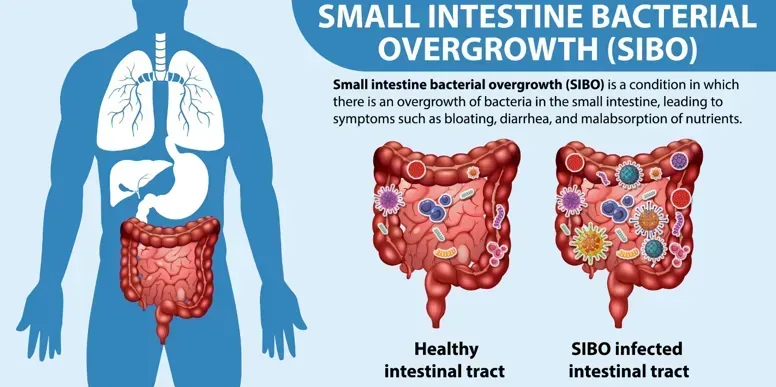
5 Signs Your Irritable Bowel Syndrome (IBS) is Really SIBO

Share this article

What does snacking, food poisoning, antibiotics, probiotics and fermentable sugar all have in common?


They may seem unrelated, but they are actually clues that your Irritable Bowel Syndrome (IBS) may actually have an underlying cause that is both testable and treatable. Can you imagine not having to deal with embarrassing gas, uncomfortable bloating, debilitating abdominal pain or annoying diarrhea and constipation? Instead, imagine yourself feeling comfortable in your own body, not having to worry if your next meal will wreak havoc on your body.


This underlying cause may be Small Intestinal Bowel Overgrowth (SIBO). It is estimated that up to 78% of adults diagnosed with IBS actually have SIBO- a condition in which an excessive amount of bacteria end up residing within the small intestines. As a result, dietary fibre gets fermented by these bacteria, causing IBS-like symptoms of bloating, belching, flatulence, abdominal pain/cramping, diarrhea or constipation (or alternating between both), nausea and heartburn.


Because IBS is diagnosed only once every other condition is excluded, it’s vital that SIBO get ruled out, as well. The following signs may lead you to suspect your IBS is actually SIBO.


Sign #1: It All Started After a Case of Food Poisoning

Let’s take a trip down memory lane. Did your bloating, gas and bowel irregularities start after a bad case of traveler’s diarrhea in Mexico? Okay, so it may not have been Mexico, but you get the point. It was likely that time you had the diarrhea-that-ruined-your-tropical-vacation (aka. acute infectious gastroenteritis). If you’ve had this form of gut insult, you’re not likely to forget it and you’re not alone. Up to 17% of people develop new IBS symptoms following a bout of acute infectious gastroenteritis and up to 40% of those people were travelling at the time. Let’s be clear, this shouldn’t discourage you from travelling, because exploring the world is the bee’s knees. But, it should highlight to you that your IBS may have something to do with an imbalance in the bugs in your gut. Travelers diarrhea reduces the “good” bacteria in your gut that are important protectors from further invasion by opportunistic bugs. This process has emerged as a key factor in the development of IBS and SIBO.


Sign #2: Your Symptoms Get Worse with Probiotics

If you’ve had IBS for any length of time, you’ve likely heard that probiotics can be helpful in the treatment of IBS. While this is true, I often encounter patients in my clinical practice that experience no change in their IBS symptoms with probiotics or they actually feel worse when taking probiotics. For those people in the latter group, it is one of the clues that suggests their IBS could actually be SIBO. This is because SIBO is an overgrowth of bacteria in the small intestine, so adding more bacteria in the form of probiotics actually can make matters worse. It’s like trying to solve a crossword puzzle by adding more crosswords- you’ll never solve the whole puzzle!


Sign #3: Your Symptoms Improve with Antibiotics

This is an interesting one, because antibiotics are implicated in both the development of IBS and in the treatment of SIBO – a catch 22. So, let me break this one down. If you have a long history of antibiotic use for various infections over your lifetime, this increases your risk of developing SIBO-associated IBS. The reason is similar to that for food poisoning- antibiotic use obliterates the good bacteria in your gut needed to protect you from overgrowth of opportunistic bugs. Now, I am not suggesting that antibiotics are always bad- they play an important role in preventing disastrous illness and even death. But, it is important to understand that when they are used, they can have their own set of consequences including the development of SIBO-associated IBS.


Since SIBO is an excessive growth of bacteria, part of the treatment is to kill this overgrowth with natural anti-microbials or with antibiotics. If you have taken an antibiotic and you find that you’re IBS symptoms improve, it could be because you have actually reduced the bacterial overgrowth without realizing it. For this reason, I always ask my IBS patients for their history of antibiotic use.


Sign #4: You Are A Constant Snacker

Believe it or not but your snacking habits can be a risk factor in the development of SIBO. We’ve discussed how SIBO is an overgrowth of bacteria in the small intestine. However, this overgrowth can only occur when there is a slow-down in the transit time of food through the small intestine. Usually, the transit time is fast enough to discourage bacterial growth, because the bacteria don’t have time to stick to the intestinal wall and grow. In SIBO, bacteria have time to grow because the small intestinal “waves” (peristalsis) that propel food forward is diminished. These peristaltic waves of electrical current are known as the migrating motor complex (MMC) and are turned on during fasting (2 hours after eating). This is where snacking comes in. If you are someone who likes to snack frequently throughout the day, you don’t allow your body to go into the fasting phase of digestion. Therefore, your MMC won’t turn on and your intestinal waves are slowed, setting you up for growth of bacteria in the small intestine.


Sign #5: You Feel Better On A Low FODMAP Diet

A low FODMAP diet has become the leading dietary intervention for IBS management. FODMAP stands for Fermentable Oligo- Di- and Monosaccharides And Polyols. Basically, FODMAPs are food containing certain types of sugars that are fermentable by bacteria in your gut. When you consume a diet high in FODMAP foods, you are encouraging this fermentation process which can lead to gas, bloating, abdominal pain and changes in bowel habits. For people with SIBO who consume high FODMAP food, these symptoms can be exaggerated because there is an increase in bacterial fermentation. If you have IBS and feel better on a low FODMAP diet, this gives a clue that there could be an underlying bacterial overgrowth. In other words, it’s not enough to live your life following a low FODMAP diet, you have to identify and treat the underlying cause so that high FODMAP food are better tolerated.


References:

  1. Simrén,M. et.al. Intestinal microbiota in functional bowel disorders: a Rome foundation report Gut. 2013 Jan; 62(1): 159–176.
  2. Ghoshal UC, Srivastava D. Irritable bowel syndrome and small intestinal bacterial overgrowth: meaningful association or unnecessary hype. World J Gastroenterol. 2014;20:2482–2491.
  3. Mezzasalma, V. et al. A randomized, double-blind, placebo-controlled trial: the efficacy of multispecies probiotic supplementation in alleviating symptoms of irritable bowel syndrome associated with constipation. Biomed Res Int. 2016 Aug 9.
  4. Chedid V, Dhalla S, Clarke JO, Roland BC, Dunbar KB, Koh J, Justino E, Tomakin E, Mullin GE. Herbal therapy is equivalent to rifaximin for the treatment of small intestinal bacterial overgrowth. Glob Adv Health Med. 2014 May;3(3):16-24.
  5. Mansueto P, Seidita A, D’Alcamo A, Carroccio A. Role of FODMAPs in patients with irritable bowel Nutr Clin Pract. 2015 Oct;30(5):665-82.


Dr Klassen

Dr. Klassen enjoys working with all patients but she has a particular interest in digestive health. Her empathetic approach to digestive concerns stems from her own personal health journey and the healing she has found in naturopathic medicine. She commonly teams up with men and women affected by irritable bowel syndrome (IBS), food sensitivities, Crohn’s, Ulcerative Colitis, reflux, bloating, diarrhea and constipation. Dr. Klassen also treats women’s health concerns such as hormone imbalances (PMS, menopause, PCOS, thyroid dysfunction), menstrual disorders (painful periods, uterine fibroids, irregular periods), fatigue, fertility issues and perinatal health. Book a free 15 minute ‘meet & greet’ to discuss your health goals with Dr. Klassen today!

Recent Posts

December 15, 2025
 Small Intestine Bacterial Overgrowth Natural Treatment with Timeline Small Intestine Bacterial Overgrowth Natural Treatment with Timeline Gut Health | Sibo | Naturopathic Medicine October 27, 2025 • 11 min read Struggling with SIBO symptoms like bloating and digestive distress? A groundbreaking 2014 study (Chedid, et al., 2014) revealed that natural herbal treatments can be just as effective as antibiotics —but there's a specific timeline and approach that determines success or failure. Key Ta
December 15, 2025
 3 TIPS FOR SPRING CLEANING YOUR CUPBOARDS 3 TIPS FOR SPRING CLEANING YOUR CUPBOARDS Community Care | Family Naturopathic Care April 22, 2015 • 3 min read Whether or not spring beckons you to start cleaning, consider a spring-cleaning of your kitchen and pantry. Take this month to consciously look at what is in your kitchen cupboards and make a move to get rid of processed foods and to restock with whole foods. Processed foods are detrimental to our health in several ways. Refined grains (anyth
December 15, 2025
 Your hormones and the DUTCH test Your hormones and the DUTCH test Womens Health | Hormones | Dutch Testing February 02, 2018 • 3 min read Hormones and hormonal imbalance are always hot topics, and with good reason. Your body is constantly being affected by your body’s mini messengers, and if they’re out of whack, you’re probably not feeling on top of your game. Fatigue, insomnia, depression, anxiety, low libido, and irregular menstrual cycles are just a few of the common symptoms of hormone im
December 15, 2025
 6 Free and Easy Ways to Take Control of Your Health and Wellbeing Now 6 Free and Easy Ways to Take Control of Your Health and Wellbeing Now Naturopathy May 11, 2017 • 3 min read Do you put the wellbeing of others before your own? Your kids? Your spouse? Your friends and family? Do you find it difficult to find the time to take care of your own health? If this is you, you’re not definitely not alone. As a naturopathic doctor, I can easily put the health of my patients first if I’m not intention
December 15, 2025
 A 3-Pronged Approach to Help Your Gut and Overall Health A 3-Pronged Approach to Help Your Gut and Overall Health Gut Health | Sibo May 30, 2020 • 3 min read A lot goes on in our intestines and it effects our physical and mental health. Our gut is part of our immune system. Keeping it’s lining from being irritated and keeping a healthy balance of good bacteria in the right places in it is very important for body including our brain. SIBO is common in our society. People often have it and don’t
December 15, 2025
 Becoming an ND Becoming an ND Naturopathy January 12, 2013 • 5 min read After graduating university, I landed a job with a pharmaceutical company as formulator and product development chemist. I was eager to begin using my double major degree in Biology and Chemistry in a health related field. I always knew I wanted to be in the health field, and I found comfort in knowing I was helping others. Interestingly, life, the universe or whatever you want to call it was about to deliver a message, “H
December 15, 2025
 Food Sensitivities Vs Food Allergies Test Food Sensitivities Vs Food Allergies Test Gut Health | Naturopathy | Sibo | Food Sensitivities August 17, 2018 • 2 min read Knowing the difference is very important as many people will use food sensitivities or tolerances interchangeably with food allergies. These are two very different tests and tell us very different things. They are not the same. Food Allergen Food allergies are tested from the classic IgE immunoglobulin in the blood and react very
December 15, 2025
 Cupping Helps Michael Phelps Cupping Helps Michael Phelps Community Care | Mens Health | Naturopathy | Womens Health August 12, 2016 • 1 min read I love the Olympics and while watching earlier this week I was super excited to see Michael Phelps sporting cupping marks on his skin while in the swimmers starting block. As a Naturopathic Doctor, it is one of many tools that I use to help people with their health concerns, in particular muscular pain and recovery. So, I was excited to see an elite
December 15, 2025
 Got a Flu, Now what? Got a Flu, Now what? Naturopathy | Cold and Flu October 19, 2015 • 5 min read At this point you are probably miserable and annoyed you caught the bug. So now what? Most of us have a set routine; maybe it is over the counter medications or something else. In this article I have given you some solid tips that I have used for myself, my kids and for my patients. As mentioned in my previous newsletter article hate having a flu , taking Vitamin C right away at first set of symp

December 15, 2025
 Dietary Intervention for Children with Autism, ADHD, Developmental Delays and Learning Disorders Dietary Intervention for Children with Autism, ADHD, Developmental Delays and Learning Disorders Community Care | Naturopathy | Hormones | Family Naturopathic Care May 30, 2015 • 3 min read Chances are you know someone with a child who has been diagnosed with some sort of brain disorder, or you may be parenting one or more children with a diagnosis that falls into the spectrum of brain or psycholog
Show More